


“The kingdom of God is within you.”
— Luke 17:21, KJV
I. The Faith That Became a Mask
Christianity remains the West’s dominant religious inheritance and, across much of it, its largest professed faith. Churches still command skylines; Christian stories and symbols inhabit sanctuaries and graveyards, paintings and songs, law and political speech. Even where belief has thinned, the civilization continues to speak in Christian accents. Yet a society can preserve the signs of a faith while refusing its judgment. It can raise cathedrals to Christ and arrange its life around evils he condemned.
The claim is severe but difficult to evade: Western societies often do not live by the Christian principles they invoke. The betrayal begins when words are severed from conduct. Truth becomes whatever power can enforce; peace becomes the silence imposed after resistance is broken; love contracts into loyalty toward those who resemble us. The vocabulary remains Christian, but its grammar is reversed: domination calls itself order, conquest calls itself security, vengeance calls itself justice, and indifference calls itself innocence.
This moral crisis is written across bodies and borders. It appears when wars of aggression are blessed as necessity, racism is defended as nature or tradition, colonial conquest clothes itself in civilization or mission, and peoples are subjugated for wealth, territory, prestige, or fear. It appears in violence hidden by law, oppression protected by institutions, and wounded lives made invisible so that the powerful may continue to feel righteous. Western societies did not invent these evils, but societies shaped by Christianity cannot invoke Christ as ornament and refuse him as measure.
This essay enters that fracture. It seeks neither nostalgia for Christian empire nor a private spirituality that escapes the world. It asks what Christianity’s central demands—truth without propaganda, peace without subjugation, and love without exclusion—require of conscience, society, and state. It follows those demands through scripture and creed, councils and buried codices, mystics and reformers, the rescue of a threatened neighbor, and the terrible atrocities of war. At every stage, the test is ethical: How should we speak when lies are useful? How should we resist evil without becoming its mirror? How should we treat the stranger, the wounded, and even the enemy?
To rediscover the Christian message is not to recover a slogan. It is to bring every sacred claim before the bodies it blesses or breaks. If Christianity is to become more than a facade, truth must be spoken, peace must be made, and love must be lived.
II. The Fire No Throne Could Command
At Jerusalem’s edge, beneath a noon-darkened sky, Rome raised a cross and believed it had ended an argument.
A condemned man hung outside the city wall. His followers scattered. Stone closed over his body. Empire had spoken in its oldest language: fear, iron, and finality.
Then the tomb was found empty.
Women bore impossible news to men who could not believe them. Locked doors could not keep hope out. Weeks later, a sound like violent wind filled a house; tongues as of fire came to rest upon ordinary heads, and strangers heard the mighty works of God in languages not their own.
Before Christianity became a cathedral, it was a wound that did not ripen into vengeance, a death that did not become defeat, and a fire no throne could command.
Yet the fire did not point to itself.
The first Christians did not begin with a finished cathedral of doctrine. They proclaimed Jesus crucified and risen—Messiah and Lord—in whom God’s reign had drawn near; spiritual intensity by itself was never the gospel. Before the canon, the agreed list of authoritative biblical books, and before the creed, the shared language of belief, they read inherited scriptures, baptized, prayed, broke bread, recognized leaders, faced moral demands, and argued. The fire came first, but it immediately began to take form.
Here the fire names the Holy Spirit in action and the life the Spirit kindles—not the Kingdom itself. Scripture and creed, sacraments—visible rites such as baptism and Communion—ordered leadership, discipline, art, and community became vessels of Christian memory: ways of carrying what one generation had received into the life of the next. Yet fervor can counterfeit the Spirit, and no vessel—however ancient, beautiful, or powerful—can possess the flame.
Read through the life and teaching of Jesus, the fire takes a moral shape that can be gathered into three inseparable demands: truth, peace, and love. Truth is fidelity to what is real before God—the refusal to turn useful falsehood into righteousness. Peace is not the silence imposed by the strong, but the restoration of right relationship through justice, mercy, and reconciliation. Love seeks the good of neighbor and enemy alike, refusing both indifference toward the wounded and hatred toward the wrongdoer. These are not three ornaments placed beside one another. Truth without love becomes a blade; peace without truth becomes the quiet of the prison; love without either dissolves into sentiment, unable to defend the wounded (Matthew 5:9, 37–48; Mark 12:28–34; John 18:37).
Jesus preached within his people’s prophetic hope that God would judge oppression and renew the world, under a Rome that named domination peace. Some priestly elites accommodated empire; the Temple remained a house of prayer and hope. He announced God’s reign, which judges domination, accommodation, privatized faith, and revolutionary vengeance. [1]
The New Testament gives God’s reign less as an abstract definition than as a movement before our eyes. It grows unnoticed like seed and yeast, runs down the road in a father rushing toward his ruined son, kneels beside a stranger in the dust, and stands in judgment wherever the least are fed, welcomed, clothed, and visited.
Luke’s phrase—traditionally rendered “the Kingdom of God is within you”—also has an alternative interpretation. The Greek phrase entos hymōn has been rendered both “within you” and “among you.” Because Jesus addresses Pharisees and speaks of a reign already present rather than observably arriving, many translators prefer “among you” or “in your midst.” Both readings have serious defenders; the phrase should bear no more than it can prove. [2]
Even if Luke means “among you,” Paul and John still carry the reign inward through life in Christ and the indwelling Spirit. Read within that wider witness, “within” names transformation and “among” names presence and relationship. The Kingdom enters persons without becoming private, becomes visible in shared life without becoming anyone’s property, and remains promised beyond every form that tries to contain it.
Shared life requires form, but betrayal begins when the vessel mistakes itself for the Kingdom—or when private certainty refuses to be tested. Doctrine names the Christ whom the Church proclaims; yet sustained cruelty discredits any claim to embody him. In Matthew’s judgment scene, whatever is done to “the least of these” is done to Christ himself. The Incarnation—the Christian belief that God truly entered human life in Jesus, who was fully divine and fully human—means that bodies cannot be treated as spiritually unimportant. Whether the phrase points especially to Jesus’ vulnerable disciples or more broadly to vulnerable neighbors, the wider New Testament witness binds fidelity to Christ to love of the hungry, the stranger, the sick, and the imprisoned (Matthew 25:31–46; John 1:14; 1 John 4:20–21). [3]
Institutional authority, inward illumination, and coercive power can each dress themselves as God’s reign. The disguise fails where conviction becomes action and another life is placed in our hands. Then the question is no longer whose certainty burns brightest, but what that certainty permits: What may we do in the name of truth, order, rescue, or God—and whom might our conviction leave bleeding and unprotected?
III. The Flame Takes Form
As the fire crossed languages and imperial roads, the vessel began to take shape around it. Questions traveled beside the gospel like shadows: Who was Jesus? Which writings carried authority? How should visions be tested? Memory needed practices after emotion faded, communities needed leaders as eyewitnesses died, and faith needed words capable of crossing generations. Walls could shelter that memory—or turn sanctuary into privilege.
The historic Nicene tradition—the broad family of churches shaped by the Council of Nicaea—confesses, meaning that it publicly binds itself to a shared faith: one Creator; Jesus Christ as truly divine and truly human, crucified and bodily risen; the life-giving Spirit; and the renewal of creation. Around that center, churches still differ over how scripture, tradition, worship, reason, and communal judgment should listen to and correct one another. [4]
Most Christian churches receive the same twenty-seven-book New Testament. The Ethiopian Orthodox Tewahedo Church places those books within a broader thirty-five-book New Testament canon. [5] The canonical boundaries differ; the central proclamation holds: Jesus Christ was crucified and rose from the dead. Creed gives identity a voice; worship gives memory a body; history and reason expose the moments when either becomes distortion.
The canon’s many voices do not collapse into one tone, but Christian reading gathers them around a cruciform center—Christ crucified. There divine power appears not as domination but as self-giving love (Philippians 2:5–11; 1 Corinthians 1:18–25) and reveals God’s character and action (Colossians 1:15; Hebrews 1:1–3). The cross becomes both revelation and judgment: it shows Christians the God they proclaim and tests the power they exercise.
This is a Christian confession, not a neutral rule imposed on every reader: the New Testament presents Christ as the decisive disclosure of God’s character. The cross therefore becomes a judgment upon Christian power. Yet it cannot be used to silence the Bible’s harder voices. Conquest stories and visions of judgment must remain within view—not as blank checks for violence, but as texts that force Christians to ask whether they are reading scripture or recruiting it. A cruciform reading—one shaped by the cross—neither erases moral difficulty nor permits difficulty to be weaponized.
By the second century, disputes over the Creator, Jesus’ flesh, creation, and resurrection had multiplied. Marcion rejected Israel’s scriptures; some Valentinian groups described salvation as awakening from ignorance and returning to divine fullness, even while sharing certain texts and rites with other Christians. [6]
Beneath many disputes lay a stark question: Does salvation rescue us from creation, or heal creation in the incarnate Christ? And if competing teachers each claim revelation, how can any claim be tested where others may see and answer it?
Irenaeus answered teachings he judged distorted by making Christian memory public. His rule of faith—a summary of what churches believed they had received from the apostles—named one Creator, Jesus Christ incarnate, crucified and risen, the Spirit, the Church, and final hope. He defended that inherited teaching and the authority of the four Gospels—Matthew, Mark, Luke, and John. [7] For him, truth could not be the private possession of a solitary visionary; it had to be confessed, practiced, and tested in the life of churches.
The New Testament canon did not descend as a finished table of contents, nor did one council create it by decree. It emerged slowly through worship and copying, teaching and regional use, connection to the apostles and Christianity’s earliest witnesses, and the judgment of different churches. In 367, Athanasius’s Thirty-Ninth Festal Letter preserved the first surviving list matching the twenty-seven books received by most Christian traditions today; regional synods later converged on comparable lists. [8]
Creed and canon grew beside one another rather than arriving in a single decree. Decades before Athanasius’s list, Emperor Constantine summoned bishops to Nicaea in 325. Amid theological controversy and imperial pressure, they declared that Christ was not a lesser divine being beneath God but “God from God, Light from Light”—fully sharing the Father’s divinity.
Nicaea sharpened rather than exhausted the mystery. Later controversy asked whether Christ was human only in body, or whether he had entered the whole depth of human life—mind and soul. Against Apollinaris, Gregory of Nazianzus gave the answer enduring form: whatever Christ did not take into himself could not be healed. If any part of our humanity remained outside the Incarnation, it remained outside redemption. The Council of Constantinople in 381 rejected teachings that diminished Christ’s complete humanity; in 451, the Council of Chalcedon gathered these convictions into a lasting statement of faith: Jesus Christ is one person, fully divine and fully human, with neither his divinity nor his humanity diminished, confused, or divided. [9]
Yet doctrine was never spoken outside history. Differences of language and theology, struggles over church authority, and imperial coercion turned the dispute over Chalcedon into a lasting breach. The churches that accepted Chalcedon remain separate from the Oriental Orthodox churches—the Coptic, Armenian, Syriac, Ethiopian, and related churches—even though both sides confess Christ as divine and human. Words meant to guard encounter can give mystery a durable grammar; enforced by power, the same words can harden into walls. [10]
Yet form could also make mercy durable. In the fourth century, Basil of Caesarea gathered worship, discipline, and care for the sick—especially people afflicted with leprosy—into the complex later called the Basiliad. Compassion acquired rooms, beds, stewards, and a life beyond its founder. [11]
Power repeatedly stole the language of the Kingdom. Many American churches defended slavery and segregation; abolitionists and Black Christian communities opened the same scriptures and found instruments of resistance. The Deutsche Christen (“German Christians”) movement bent the cross toward race, blood, and nation. Tradition therefore carried a divided inheritance: instruments by which domination was blessed and words by which its lies were exposed. [12]
Colonial power carried the same theft across a wider map. Christian mission and empire were not identical, and missionaries sometimes defended the peoples empire exploited; yet mission also traveled beside conquest, racial hierarchy was clothed in providence, and the nation was treated as though it were God’s chosen vessel. Modern war propaganda repeats the pattern whenever it baptizes one people’s fear as innocence, its violence as necessity, and its enemies as lives outside moral concern. The theological test is not whether power speaks Christian words, but whether its fruits resemble Christ: truth without propaganda, peace without subjugation, and love that refuses to make any people disposable. [13]
Not every blaze is Pentecost, nor every shattered wall liberation. Every authority remains under Christ, who heals the excluded, loves enemies, refuses the sword in his defense, and entrusts vindication to God.
IV. What the Desert Gave Back
The Nag Hammadi library is a cache of ancient handwritten books discovered near the town of Nag Hammadi in Upper Egypt. According to the traditional account, local farmers found the papyrus codices in a jar near the Jabal al-Tarif cliffs in 1945, and the desert released a buried archive. What survives comes from thirteen codices in varying states of preservation and contains more than fifty texts in Coptic, the Egyptian language then used by many Christians. Copied mainly in the fourth century from earlier works, usually composed in Greek, the books preserve voices that had fallen silent; who made, read, or buried them remains disputed. [14]
If councils test whether public authority can preserve truth without possessing it, the Nag Hammadi codices test the opposite temptation: mistaking hiddenness, exclusion, or inward illumination for purity. Recovered texts may expose what institutions suppressed; suppression alone cannot make a text true.
The collection includes the Gospel of Thomas, the Gospel of Philip, the Gospel of Truth, the Apocryphon of John, and many other works. It is not a single rival Bible but an archive of competing visions. Several texts present revelation as secret teaching given by the risen Jesus to a chosen disciple rather than through a public account of his ministry, death, and resurrection. Some redraw Genesis, distinguish the highest God from an ignorant or hostile maker of the material world, and describe salvation as awakening to a hidden divine origin rather than the healing of creation through Christ’s Incarnation, cross, and bodily resurrection. Others—especially Thomas—carry little of this mythology and instead gather sayings about knowledge, perception, and a Kingdom already present. The differences are real; even the label “Gnostic” can flatten movements that shared no single identity or system. [15]
The Apocryphon of John depicts the lower cosmos as governed by ignorant powers. Set beside the canonical hope for creation’s renewal, it sharpens a question: is the world a prison to escape, or a wounded creation awaiting transfiguration? The contrast is real, but not absolute. The Apocryphon sees a cosmos darkened by ignorance; Thomas, with a different vision, trains the eye upon the light already near. The codices do not speak with one voice.
The Gospel of Thomas gathers 114 sayings attributed to Jesus. It offers no continuous account of his birth, public ministry, crucifixion, or resurrection. Some sayings echo Matthew, Mark, and Luke; others alter familiar teachings or appear nowhere in the New Testament. The collection is often dated to the second century, although its date, compositional history, and the independence of individual sayings remain disputed. [16]
Thomas does not name “mystical experience” in modern psychological terms, but it repeatedly presents salvation as awakened sight. Saying 3 places the Kingdom “inside” and “outside” and joins self-knowledge to becoming known. Saying 77 finds Jesus’ light throughout reality—split the wood, lift the stone, and he is there. Saying 113 declares that the Father’s Kingdom is spread across the earth, yet people do not see it. Here the Kingdom is not chiefly a country beyond death or a political order arriving from outside; it is a hidden reality already within and around us, disclosed when perception changes. The language of inward recognition, pervasive presence, and transformed sight invites a mystical reading, though Thomas offers no systematic account of contemplation.
Yet the Gospel of Thomas cannot bear the mythology modern readers sometimes place upon it. A buried or forbidden text is not therefore a purer text, and Thomas does not deliver an uncorrupted Jesus rescued from the Church. Secrecy can build its own hierarchy; a collection of luminous sayings can still be severed from the people, bodies, and conflicts among which Jesus lived.
For Nicene Christianity, these texts are provocation, not replacement. The New Testament also knows secrecy, inwardness, and illumination, but the four canonical Gospels place revelation inside public relationships: Jesus feeds, heals, eats with the despised, blesses the poor, and receives imperial violence without returning it. Paul speaks of Christ living within; John, of the Spirit dwelling within and love as the sign that one abides in God (Galatians 2:20; John 14–17; 1 John 4:7–21). Thomas asks whether the Kingdom is nearer than habit permits us to see; the canonical story insists that awakened sight must find the suffering body before it. Sight that passes by that body is not yet mercy.
The desert did not return a lost, pure Christianity or a single alternative New Testament. The codices did not abolish the cathedral; they revealed a late-antique Christian world more contested than triumphal histories admit. They reopened questions the centuries had buried but never answered.
V. The Flame at the Heart of Silence
Mysticism begins from the conviction that ultimate or divine reality may be encountered directly, not merely described. More precisely, it is the disciplined search for a transforming awareness of God—or, in some traditions, of ultimate reality—through meditation, prayer, contemplation, silence, fasting, worship, and ethical discipline. Mystics are women and men whose lives and writings are shaped by a perceived direct encounter with the divine. A mystical experience is a moment of unusually immediate awareness, interpreted through inherited language and tradition—as light, darkness, silence, union, surrender, emptiness, or love beyond speech. Mysticism is the long river of practice and interpretation; an experience is a moment when its current is felt. Such moments may transform, but they grant no infallibility and cannot certify their own source. [17]
Across religions, this longing has spoken in different grammars. Christian mystics include Augustine, Pseudo-Dionysius, Hildegard of Bingen, Meister Eckhart, Julian of Norwich, Teresa of Ávila, John of the Cross, and Thomas Merton; Islam has Rābiʿa al-ʿAdawiyya, Rumi, and Ibn ʿArabi; Judaism has Isaac Luria and the Baal Shem Tov; South Asian devotional traditions include Kabir and Mirabai, while Hindu mysticism includes Ramakrishna; Sikhism has Guru Nanak; and Buddhism has Milarepa and Dōgen. Their beliefs are not interchangeable. Mysticism names a family of practices and claims, not one hidden religion beneath them all. [18]
Nor did mysticism remain behind monastery or temple walls. Through Plotinus, Eckhart, and Simone Weil, it reshaped philosophy; through Hildegard, Rumi, Kabir, Mirabai, John of the Cross, and William Blake, it gave humanity beautiful, timeless music, poetry, and literature. Through Joan of Arc, Mahatma Gandhi, and Dag Hammarskjöld, spiritually disciplined lives entered public action and political leadership. Mystics founded communities, advised rulers, challenged religious institutions, nourished movements for peace and justice, and gave words to experiences ordinary speech can barely hold. [19]
Nicene Christianity, then, need not leave its own inheritance to find a contemplative river. Scripture, sacrament, monastic discipline, silence, repentance, and mercy have carried it across centuries. Earlier Christians rarely used mysticism in its modern broad sense; they spoke of meeting God in darkness and silence, sharing in God’s life, discovering God’s presence within, and coming to know God through meditation, prayer, purification, community, and service.
The contemplative tradition therefore inherits disciplines for testing experience. Not every light is revelation; not every unity is love. A vision may be delusion, and a sense of transcendence may leave cruelty untouched. Communities test spiritual claims through scripture, moral fruit, seasoned judgment, and common life. Institutions can make discernment possible—and can also build walls against truth.
Augustine enters through the divided self. His inward turn does not end in self-worship; he finds God more inward than his inwardness and higher than his highest reach. In memory he encounters life as gift rather than achievement—a restless life unable to heal its own desire, yet summoned into love. [20]
Maximus the Confessor opens this movement toward the cosmos. Humanity stands amid creation’s divisions, called toward reconciliation in Christ rather than escape from matter. Theosis, participation by grace in God’s life, reconciles difference in communion. Spirituality that despises flesh has mistaken the fire: the Word became flesh. [21]
Teresa of Ávila returns union to the discipline of a life. Her Interior Castle turns inward through prayer, self-knowledge, trial, and surrender, yet spiritual marriage must bear courage, service, humility, and love. Consolation is not proof; union that refuses costly love confuses sweetness with the work of God. [22]
These witnesses turn inward not to enthrone a private self, but to break its prison. Christian inwardness depends on grace, takes the incarnate Christ as its form, accepts correction, and returns to the world as costly love. Jesus’ words—“You will know them by their fruits” (Matthew 7:16, 20)—place every spiritual claim beneath a public test.
A church may confess the Incarnation while ignoring bodies, defend the Eucharist—the sacred meal of Communion—while neglecting the hungry, and preach holiness while protecting abuse. When conduct betrays symbol, the symbol rises as a witness against the church: the Eucharist condemns abandonment; the Incarnation, contempt for flesh; the cross, power that sacrifices others.
Contemplation schools the surrender of fantasy, privilege, hatred, and the desire to master. The Spirit burns within the vessel as gift and judgment, never possession.
Then a cry tears through the silence of the cloister. One body is in danger, another threatens it, and a third can act. If spiritual claims are known by their fruits, their severest public test comes when love of the threatened and love of the aggressor appear to demand incompatible acts.
VI. Where Love Meets the Blow
Leo Tolstoy (1828–1910), the Russian novelist who wrote War and Peace and Anna Karenina, had reached the summit of literary fame when success ceased to answer the question of how one should live. A profound religious and moral crisis drove him toward the Gospels. Convinced that churches and states had domesticated Jesus’ commands to justify hierarchy, punishment, military service, and war, he turned his literary authority toward a radical reading of the Sermon on the Mount. He rejected central Nicene doctrines, including the Trinity—the belief that the one God is Father, Son, and Holy Spirit—and Christ’s bodily resurrection, yet his indictment of Christian coercion enters the cathedral like a prophet’s cry.
In The Kingdom of God Is Within You, published outside Russia in 1894 after censorship prevented its appearance at home, Tolstoy turns Luke’s phrase into an indictment. The Kingdom begins within conscience as a refusal of hatred, revenge, war, and obedience to institutions sustained by coercion. The book’s implication is severe: Christianity is not chiefly assent to doctrine or participation in ritual, but a way of life that makes state violence and Christian discipleship fundamentally incompatible. His argument helped shape Gandhi’s commitment to nonviolence and, through later movements, the moral vocabulary of modern civil resistance. [23]
These demands converge where another life is placed in danger. The Gospels require truthful speech, bless peacemakers, command reconciliation and love of enemies, and join love of God to love of neighbor (Matthew 5:9, 23–24, 37–48; Mark 12:28–34; John 18:37). The dispute begins not over whether truth, peace, and love bind the Christian conscience, but over what love requires when peace has already been broken and protecting one neighbor appears to demand injuring another.
To make the cost visible, Tolstoy imagines an observer killing a known ruffian who is pursuing a girl. The aggressor’s death is certain; the harm supposedly prevented remains unknowable. Once danger creates an exception, fear easily turns a person into a threat and violence into defense.
Nonviolence, however, is not the stillness of a spectator. It warns, opens a path of escape, offers shelter, stands between aggressor and victim, and restrains without injury whenever possible. [24]
Now place a child between these principles and a blow. Suppose rescue requires injuring the aggressor. Aquinas permits moderate self-defense; Catholic teaching says legitimate defense can become a grave duty for one responsible for another’s life. [25] Yet Jesus healed the wounded man at his arrest, ordered his disciple to put away the sword, and said that his Kingdom did not depend on followers fighting to prevent his arrest (Matthew 26:52; Luke 22:51; John 18:36). Strict Christian pacifists—Christians who believe Jesus forbids his followers from deliberately injuring another person—may stand between aggressor and victim, even at personal risk, while refusing to wound the aggressor. Their question pierces every easy answer: Can deliberate injury remain compatible with love for the enemy—with resistance emptied of hatred and revenge?
Scripture offers no clean exit from the dilemma. Luke 22’s references to swords and Jesus’ action in the Temple do not clearly authorize injuring someone to protect another. Romans 12–13 leave Christians divided over whether followers of Jesus may hold public office and exercise state power. [26] Yet neighbor-love demands movement toward the wounded (Luke 10:25–37; Matthew 25:31–46; 1 John 3:16–18). The Incarnation forbids indifference to the threatened body; the cross forbids surrendering the aggressor to hatred. Those obligations can collide.
Uncertainty is not a moral refuge. It burdens refusal as surely as action and cannot turn avoidable abandonment into innocence. When grave and imminent harm cannot be stopped by gentler means, force intended to restrain—even when it foreseeably causes injury—may remain compatible with enemy-love, but only when its purpose is protection rather than punishment, it inflicts no more harm than rescue requires, and it ends the moment danger passes. Killing chosen as either an end or a means remains intended killing; death genuinely foreseen but not chosen is morally different, though never an excuse for reckless or excessive force. When the struggle ends, care is owed to both. No cause makes killing holy. [27]
Nations, however, are not persons enlarged, and collective defense is not personal rescue multiplied. The analogy survives only as a duty not to abandon the threatened; authority, means, foreseeable harm, and the peace sought must all be justified anew. At the scale of nations, war can dress vengeance as rescue, while refusal can dress abandonment as innocence. A state acts through chains of command, incomplete intelligence, political interests, and weapons whose effects exceed their intended targets. Distance multiplies uncertainty—and the opportunities for moral evasion.
Before force may call itself protection, those who authorize it must answer: By what authority? Which nonviolent alternatives remain? Whose lives will be risked, under what limits, and toward what peace? Evidence, public justification, restraint, and accountability are not bureaucratic ornaments; they keep rescue from hardening into domination. [28] Real aggression may create a duty to protect, but it cannot sanctify war—or any act committed within it. Jesus’ recorded teaching contains no explicit authorization of war. [29]
Drawing on Augustine, Aquinas’s classic three-part formulation, and later Christian tradition, the just-war framework is meant to restrain the rush to violence by forcing two sets of questions. Before war: Is there legitimate authority, a just cause, a right intention, no effective peaceful alternative, proportionality, and a reasonable prospect of success? During war: Are noncombatants protected, and is each use of force proportionate? [30] The framework is a gate, not a blessing. No checklist can make war morally innocent; every decision and every act remains under judgment.
No flag or cause possesses the fire. Force that begins as protection betrays its purpose when it becomes vengeance, collective punishment, conquest, contempt for civilians, or war without an accountable end. In every conflict, truth must resist propaganda, mercy must interrupt retaliation, and power must accept limits. The Kingdom is not proved by victory. It becomes visible wherever the wounded are protected, enemies remain human, and even necessary force remains answerable to peace.
Long before weapons are drawn, the Church’s first labor is to build alternatives: shelters, accompaniment, unarmed protection, evacuation, medical aid, and civil resistance. It cannot condemn coercion while leaving others to supply it unexamined; peace must acquire institutions, training, courage, and hands.
Sometimes courage receives the blow; sometimes it stands between the blow and the defenseless. When no gentler act can save, courage may close its hand upon the descending arm—without vengeance, triumph, or forgetting that both stand before God. Love remains answerable to the endangered without surrendering the enemy to hatred.
VII. What the Darkness Could Not Take
Codices lifted from Egyptian earth and a sword drawn beneath olive trees seem to belong to different stories. Yet both ask what may claim sacred authority: hidden insight, inherited institution, coercive power, or love made visible in care for the wounded.
Texts, practices, and memories were lost. The Kingdom was not. Christians obscured it whenever eternal life excused abandonment, assent replaced discipleship, insight became possession, or power outweighed solidarity with the wounded.
The Kingdom reaches inward without becoming private and takes form among us without becoming any community’s possession. It comes as gift, summons, and promised future—a rebuke to despair.
The Kingdom becomes visible wherever truth breaks lies, peace interrupts domination and revenge, and love refuses to abandon the wounded or the enemy. Truth keeps peace from becoming submission; peace keeps truth from becoming a weapon; love binds both to every person’s dignity.
The cathedral matters when beauty points beyond itself, doctrine protects mystery without mastering it, worship sends us toward discarded bodies, and authority shelters the vulnerable. We need vessels to carry the fire; every vessel must remain answerable to the fire that judges it.
Again and again, a narrow chamber opens before the act: the breath in which fear asks permission to become hatred and power offers innocence in exchange for obedience. There truth names what is real; peace breaks domination without abandoning the endangered; and love beholds, even in the enemy, a life no cause has made disposable. By these disciplines, grace keeps suffering from becoming cruelty in our hands.
Night gathers around every cathedral. Councils end; books close; hymns fade into the rafters. The vessel cracks, yet the fire is not lost. It burns wherever truth is spoken without hatred, peace is made without injustice, and love crosses the boundary fear has drawn. No one possesses that fire; we can only bear it and pass it on.
Let truth be our light, peace our labor, and love the fire we carry into the dark.
💕
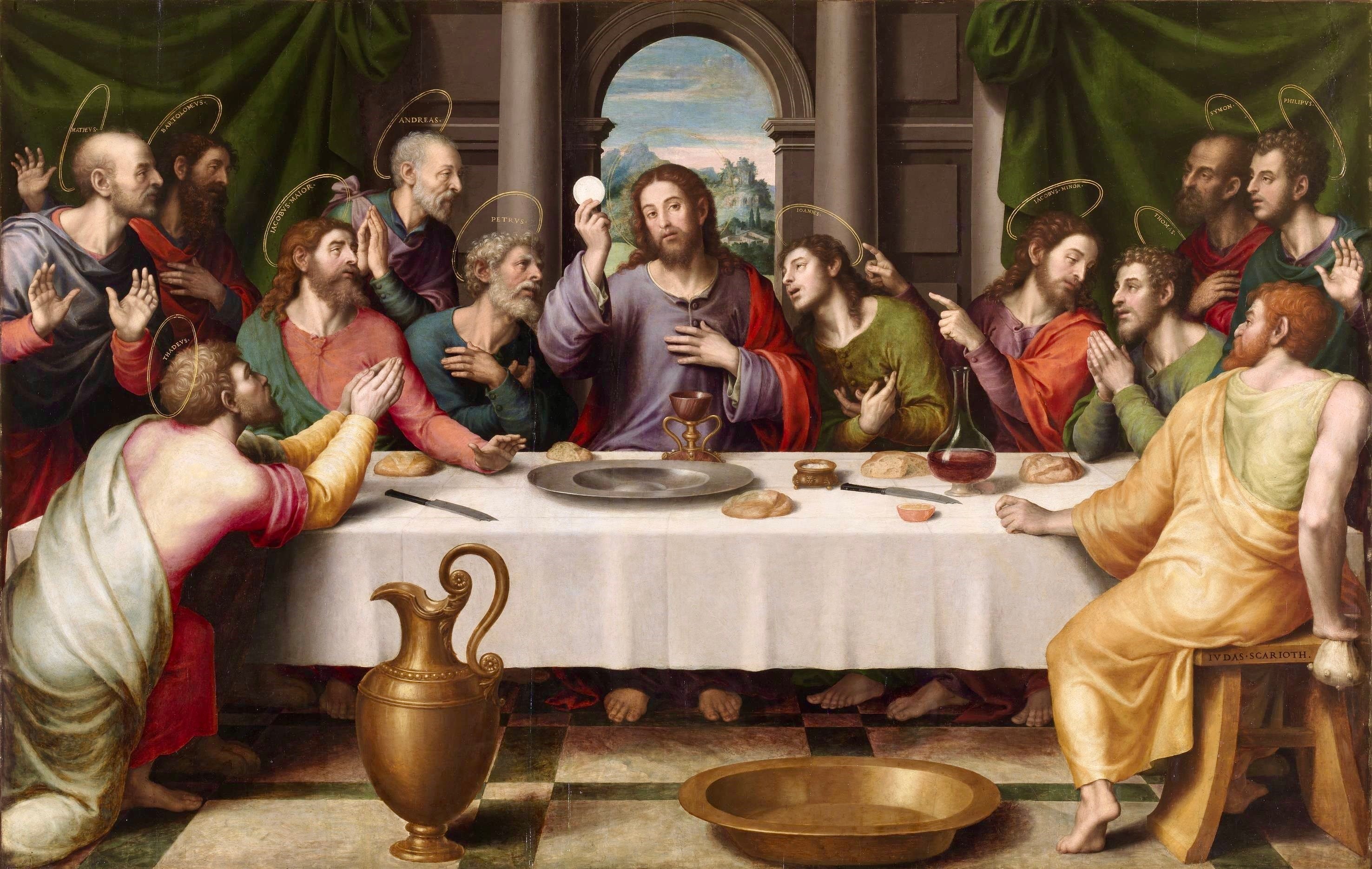
Artwork: The Last Supper, Juan de Juanes (1555–1562)
Notes and Further Reading
[1] E. P. Sanders, The Historical Figure of Jesus (London: Penguin, 1993), 169–88, on Jesus under Roman rule and the Kingdom as present and future. See also Mark 10:42–45 on domination and service; Mark 11:15–18 on the Temple action; and Matthew 5:38–48 on retaliation and enemy-love.
[2] New Revised Standard Version Updated Edition (National Council of the Churches of Christ in the USA, 2021), Luke 17:20–21. On entos hymōn and the contextual case for “among you” or “in your midst,” see Joseph A. Fitzmyer, The Gospel According to Luke X–XXIV, Anchor Bible 28A (Garden City, NY: Doubleday, 1985), 1161–62, and Joel B. Green, The Gospel of Luke (Grand Rapids, MI: Eerdmans, 1997), 629–31; for the case supporting “inside you,” see Ilaria Ramelli, “Luke 17:21: ‘The Kingdom of God Is Inside You’: The Ancient Syriac Versions in Support of the Correct Translation,” Hugoye 12, no. 2 (2009): 259–86.
[3] On the disputed identity of “the least of these” in Matthew 25:31–46, see Ulrich Luz, Matthew 21–28: A Commentary, trans. James E. Crouch, ed. Helmut Koester, Hermeneia (Minneapolis: Fortress Press, 2005), 267–74; and R. T. France, The Gospel According to Matthew: An Introduction and Commentary, Tyndale New Testament Commentaries (Leicester: InterVarsity Press; Grand Rapids, MI: Eerdmans, 1985), 354–58. The narrower reading identifies them especially with Jesus’ vulnerable disciples or emissaries; the broader reading includes the hungry, the stranger, the sick, the imprisoned, and otherwise vulnerable people more generally. The essay’s ethic of care does not depend upon resolving the dispute.
[4] Second Vatican Council, Dei Verbum (1965), paras. 9–10; Orthodox Church in America, “Tradition,” in The Orthodox Faith; and Church of England, “Articles of Religion,” arts. VI and XX. See also the Niceno-Constantinopolitan Creed, in Norman P. Tanner, ed., Decrees of the Ecumenical Councils, vol. 1 (Washington, DC: Georgetown University Press, 1990), 24.
[5] Ethiopian Orthodox Tewahedo Church, “The Bible,” which lists the twenty-seven commonly received New Testament books followed by eight additional works, for a total of thirty-five.
[6] Judith M. Lieu, Marcion and the Making of a Heretic: God and Scripture in the Second Century (Cambridge: Cambridge University Press, 2015); Elaine H. Pagels, “A Valentinian Interpretation of Baptism and Eucharist—and Its Critique of ‘Orthodox’ Sacramental Theology and Practice,” Harvard Theological Review 65, no. 2 (1972): 153–69; Einar Thomassen, The Spiritual Seed: The Church of the ‘Valentinians’ (Leiden: Brill, 2006).
[7] Irenaeus of Lyons, Against Heresies 1.10.1 on the public rule of faith; 3.3.1–4 on apostolic tradition and succession; and 3.11.8 on the fourfold Gospel.
[8] Athanasius of Alexandria, Thirty-Ninth Festal Letter (367), paras. 4–7; Bruce M. Metzger, The Canon of the New Testament (Oxford: Clarendon Press, 1987), chap. 7. Comparable New Testament lists appeared in the proceedings associated with the regional councils of Hippo (393) and Carthage (397 and 419), though the precise history of their texts and reception requires care.
[9] On Nicaea’s theological and imperial setting, see Eusebius of Caesarea, Life of Constantine 3.6–13, and Lewis Ayres, Nicaea and Its Legacy (Oxford: Oxford University Press, 2004), chaps. 4–5. On the Nicene logic of salvation, see Athanasius of Alexandria, On the Incarnation, trans. John Behr, Popular Patristics Series 44a (Yonkers, NY: St Vladimir’s Seminary Press, 2011), especially secs. 6–10 and 54; and Gregory of Nazianzus, Letter 101 to Cledonius. On Constantinople’s rejection of Apollinarianism, see the First Council of Constantinople, canon 1. On Chalcedon, see “The Definition of Faith of the Council of Chalcedon,” in Tanner, Decrees, 1:83–87, and Richard Price and Mary Whitby, eds., Chalcedon in Context: Church Councils 400–700 (Liverpool: Liverpool University Press, 2011).
[10] On the shared confession, see the 1973 Paul VI–Shenouda III Declaration and the 1989 Orthodox–Oriental Orthodox First Agreed Statement.
[11] On Basil’s complex of hospitality and care, see Gregory of Nazianzus, Oration 43: Funeral Oration on Basil the Great, sec. 63, trans. Charles Gordon Browne and James Edward Swallow, in Nicene and Post-Nicene Fathers, 2nd ser., vol. 7, ed. Philip Schaff and Henry Wace (Buffalo, NY: Christian Literature Publishing Co., 1894); and Andrew T. Crislip, From Monastery to Hospital: Christian Monasticism and the Transformation of Health Care in Late Antiquity (Ann Arbor: University of Michigan Press, 2005), especially 103, 118–19, 138. See also Daniel Caner, “Not a Hospital but a Leprosarium: Basil’s Basilias and an Early Byzantine Concept of the Deserving Poor, ”Dumbarton Oaks Papers 72 (2018): 25–48, which challenges broader descriptions of the complex.
[12] On Christian complicity and resistance in American slavery and segregation, see Mark A. Noll, The Civil War as a Theological Crisis (Chapel Hill: University of North Carolina Press, 2006), and Carolyn Renée Dupont, Mississippi Praying (New York: New York University Press, 2013). On Christianity under National Socialism, see Susannah Heschel, The Aryan Jesus (Princeton, NJ: Princeton University Press, 2008), and United States Holocaust Memorial Museum, “The German Churches and the Nazi State.” For a primary Christian resistance text concerning American segregation, see Martin Luther King Jr., “Letter from Birmingham Jail” (1963).
[13] On the entanglement of Christian theology, colonialism, and racial hierarchy, see Willie James Jennings, The Christian Imagination: Theology and the Origins of Race (New Haven: Yale University Press, 2010). On the complex history of Christian mission and empire, see Dana L. Robert, Christian Mission: How Christianity Became a World Religion (Chichester: Wiley-Blackwell, 2009). On the construction of public consent through modern war propaganda, see Susan A. Brewer, Why America Fights: Patriotism and War Propaganda from the Philippines to Iraq (New York: Oxford University Press, 2009).
[14] Paul Linjamaa, The Nag Hammadi Codices and Their Ancient Readers: Exploring Textual Materiality and Reading Practice (Cambridge: Cambridge University Press, 2024); Nicola Denzey Lewis and Justine Ariel Blount, “Rethinking the Origins of the Nag Hammadi Codices,” Journal of Biblical Literature 133, no. 2 (2014): 399–419.
[15] Michael A. Williams, Rethinking “Gnosticism” (Princeton, NJ: Princeton University Press, 1996); Karen L. King, What Is Gnosticism? (Cambridge, MA: Harvard University Press, 2003). For representative differences from the canonical Gospels, see the Apocryphon of John, Gospel of Truth, and Gospel of Philip in Marvin Meyer, ed., The Nag Hammadi Scriptures: The International Edition (New York: HarperOne, 2007).
[16] Gospel of Thomas, in The Nag Hammadi Scriptures: The International Edition, ed. Marvin Meyer (New York: HarperOne, 2007), 133–60; Simon Gathercole, The Gospel of Thomas: Introduction and Commentary (Leiden: Brill, 2014), 112–75, 207–14, and 492–96, on the collection’s date, compositional history, and individual sayings. On Thomas as a mystical or esoteric Christian tradition, see April D. DeConick, “The Gospel of Thomas,” The Expository Times 118, no. 10 (2007): 469–79.
[17] Bernard McGinn, The Foundations of Mysticism, vol. 1 of The Presence of God (New York: Crossroad, 1991), xv–xviii; Bruce Milem, “Medieval Christian Mysticism,” in The Cambridge Handbook of Western Mysticism and Esotericism, ed. Glenn Alexander Magee (Cambridge: Cambridge University Press, 2016), 107–17. The distinction drawn here between mysticism as a tradition of practices and interpretation and mystical experience as a particular awareness of God’s presence is analytical; it does not assume that all Christian mystics report one universal experience.
[18] For comparative caution, see Steven T. Katz, ed., Mysticism and Philosophical Analysis (New York: Oxford University Press, 1978); Annemarie Schimmel, Mystical Dimensions of Islam (Chapel Hill: University of North Carolina Press, 1975); and Gershom Scholem, Major Trends in Jewish Mysticism (New York: Schocken, 1946).
[19] On spiritual discipline in public life, see M. K. Gandhi, An Autobiography: The Story of My Experiments with Truth, trans. Mahadev Desai (Ahmedabad: Navajivan, 1927–29), and Dag Hammarskjöld, Markings, trans. Leif Sjöberg and W. H. Auden (New York: Knopf, 1964).
[20] Augustine, Confessions 1.1.1, 3.6.11, and 10.27.38, trans. Henry Chadwick (Oxford: Oxford University Press, 1991).
[21] Maximus the Confessor, Ambiguum 41, in On Difficulties in the Church Fathers: The Ambigua, vol. 2, ed. and trans. Nicholas Constas (Cambridge, MA: Harvard University Press, 2014), 103–49.
[22] Teresa of Ávila, Interior Castle, Seventh Dwelling, chap. 4, trans. Kieran Kavanaugh and Otilio Rodriguez (Washington, DC: ICS Publications, 1980), 444–58.
[23] Leo Tolstoy, The Kingdom of God Is Within You, trans. Constance Garnett (New York: Cassell, 1894), chaps. 2, 10, and 12. The armed-observer hypothetical appears in chap. 2. On Tolstoy’s doctrinal reconstruction, see What I Believe, trans. Constantine Popoff (London: Elliot Stock, 1885), chaps. 7–8. Tolstoy’s position differs from Nicene Christian pacifism, which retains Christ’s unique divinity and bodily resurrection. For Tolstoy’s religious crisis and rejection of war, see W. B. Gallie, Philosophers of Peace and War (Cambridge: Cambridge University Press, 1978), chap. 5, and Rosamund Bartlett, Tolstoy: A Russian Life (Boston: Houghton Mifflin Harcourt, 2011). On the book’s influence on Gandhi, see Gandhi, Autobiography, pt. 2, chap. 15.
[24] Mennonite Church USA, Confession of Faith in a Mennonite Perspective (1995), art. 22; Richard B. Hays, The Moral Vision of the New Testament (San Francisco: HarperSanFrancisco, 1996), chap. 14; Ronald J. Sider, Nonviolent Action: What Christian Ethics Demands but Most Christians Have Never Really Tried (Grand Rapids, MI: Brazos Press, 2015); Nonviolent Peaceforce, Unarmed Civilian Protection: An Introduction (2022).
[25] Thomas Aquinas, Summa Theologiae II–II, q. 64, a. 7; Catechism of the Catholic Church, paras. 2263–65. Aquinas addresses proportionate self-defense; the Catechism states that legitimate defense can be a grave duty for someone responsible for another’s life.
[26] Matthew 5:38–48; Matthew 26:47–54; Luke 6:27–36; Luke 22:49–51; John 18:36; Romans 12:14–21, NRSVue. Frequently invoked countertexts include Luke 3:14; Luke 7:1–10; Luke 22:35–38; John 2:13–17; and Romans 13:1–7. None directly supplies the authorization at issue; Romans 13 concerns governing authority rather than directly authorizing a disciple’s use of injurious force; its implications for Christian participation in public office remain disputed. For contrasting readings, see notes 24 and 29.
[27] On intended and foreseen effects, see Aquinas, Summa Theologiae II–II, q. 64, a. 7; Joseph M. Boyle Jr., “Toward Understanding the Principle of Double Effect,” Ethics 90, no. 4 (1980): 527–38; T. A. Cavanaugh, Double-Effect Reasoning (Oxford: Oxford University Press, 2006).
[28] On public justification, restraint, accountability, and the moral limits of defensive force, see Paul Ramsey, The Just War (New York: Scribner’s, 1968); Michael Walzer, Just and Unjust Wars: A Moral Argument with Historical Illustrations, 5th ed. (New York: Basic Books, 2015); and Catechism of the Catholic Church, paras. 2308–14. On punishment and restorative justice, see Christopher D. Marshall, Beyond Retribution (Grand Rapids, MI: Eerdmans, 2001).
[29] Christian arguments concerning war require more than immediate rescue. See Paul Ramsey, The Just War (New York: Scribner’s, 1968); Hays, Moral Vision, chap. 14; and John Howard Yoder, The Politics of Jesus, 2nd ed. (Grand Rapids, MI: Eerdmans, 1994), chap. 10. They disagree whether participation in any war can satisfy Christian discipleship.
[30] For the development of Christian just-war thought, see Augustine, Contra Faustum 22.74–75; Thomas Aquinas, Summa Theologiae II–II, q. 40, art. 1; and Catechism of the Catholic Church, paras. 2307–14, especially 2309 and 2312–14. Augustine supplies foundational themes; Aquinas formulates legitimate authority, just cause, and right intention; the Catechism presents the expanded modern Catholic criteria governing resort to military force and conduct in war.