


Be still.
Ask gently: Who am I?
Let every answer fall away—
Your body, story, mind.
That which remains
is silent, infinite, eternal—
the one who sees,
yet is never seen.
You are That.
There is timeless love, beauty, and unity beneath the noise of the world.
Beneath human civilization, beneath the rise and collapse of empires, beneath religion, philosophy, science, and war, there exists another current moving through human history like an underground river. Most people touch it only at a distance — in moments of grief, love, beauty, terror, or wonder — but a rare few enter it completely.
These are the mystics.
They are among the strangest figures ever produced by humanity. They appear in every civilization without invitation, emerging from deserts, forests, monasteries, mountains, temples, and forgotten villages carrying the same impossible message: that reality is far deeper than it appears, that the self is not what we think it is, and that hidden beneath the chaos of existence lies a profound and beautiful unity.
The mystic does not merely believe. The mystic experiences.
This is the difference.
The theologian speaks about God.
The philosopher reasons toward truth.
The scientist measures reality.
The mystic walks directly into the fire.
And when they return, they are never entirely the same again.
Mysticism, in its deepest sense, is the human soul dissolving its separation from existence itself. It is the soul moving beyond the narrow prison of the ego and encountering reality without the walls constructed by fear, identity, language, and thought. Across history, mystics have given different names to this encounter. Some called it God. Others called it the Tao, Brahman, Nirvana, the Infinite, the Beloved, or simply the One. Yet despite enormous differences in culture and religion, their descriptions echo each other with eerie consistency.
Again and again, they speak of overwhelming love. Of timelessness. Of light. Of silence vast beyond comprehension. Of the disappearance of the separate self. Of a reality so alive and sacred that ordinary language collapses before it.
This is why mystics so often turn to poetry. Logic can describe the surface of things, but mystical experience belongs to another realm entirely. It is closer to music than mathematics. Closer to thunder, oceans, and stars than to argument.
At the heart of mysticism lies perhaps the most dangerous idea in human history: that human beings are far more than the identities they inhabit.
Ordinary consciousness feels isolated. A person experiences themselves as a small creature moving through an indifferent universe, separated from others by skin, memory, ambition, and mortality. The mystic claims this separation is incomplete and illusory. Beneath the surface individuality of life exists an immense interconnected reality from which all things emerge and into which all things return.
For the mystic, compassion is no longer merely morality. It becomes perception. To harm another is, in a profound sense, to harm oneself. To love another is to recognize something eternal reflected back through another pair of eyes.
How these experiences occur remains one of the greatest mysteries humanity has ever encountered.
Sometimes they emerge through years of meditation beneath temple walls where the mind gradually empties itself of noise. Sometimes they arrive through prayer so profound that the boundary between worshipper and worshipped begins to dissolve. Sometimes suffering itself becomes the doorway. Extreme grief, illness, isolation, or confrontation with death can shatter the ordinary structures of identity and expose something hidden beneath them.
And sometimes mystical experience arrives unexpectedly.
A man staring at the night sky suddenly feels the universe looking back at him. A mother holding her child senses eternity moving through a single fragile moment. A soldier surviving battle sees life with unbearable clarity. A musician vanishes inside her music. A dying patient loses all fear and enters a peace beyond language.
The modern world often attempts to reduce these experiences to neurological events, and certainly the brain participates in them. Neuroscience increasingly reveals that mystical states correlate with profound changes in perception, self-awareness, and cognition. Yet even if science maps every neural pathway involved, the mystery itself may remain untouched. Explaining the chemistry of awe does not explain why awe exists.
The mystics insist these experiences are not hallucinations but revelations. Not an escape from reality, but an encounter with a deeper layer of it.
Whether they are right may remain forever unresolved.
But what cannot be denied is their transformative power.
The authentic mystic almost always returns altered. Fear of death weakens. Material obsession loses its grip. Compassion deepens. Beauty becomes almost unbearable in its intensity. The small dramas that consume ordinary life begin to feel strangely transparent.
This transformation explains why mystics have so often frightened political and religious authorities. Someone who no longer worships power, wealth, or social approval becomes difficult to control. Throughout history, mystics have repeatedly challenged civilizations intoxicated by greed, violence, and domination. They spoke with an authority that institutions could neither manufacture nor fully understand.
Some paid for it with their lives.
Socrates was sentenced to death. Joan of Arc was burned at the stake. Al-Hallaj was publicly executed. Countless unnamed mystics vanished into prisons, deserts, or silence because their experiences threatened systems built upon obedience and fear.
Yet their influence became immortal.
Mystics transformed humanity far beyond religion alone. They were among the first explorers of consciousness long before psychology existed. Buddhist contemplatives mapped the mechanics of suffering with astonishing precision thousands of years before neuroscience. Hindu sages developed profound philosophies of mind and identity. Christian contemplatives explored the architecture of inner transformation. Sufis turned divine longing into poetry and music that still move hearts centuries later.
But perhaps nowhere did mystics leave a greater mark than in art itself.
For centuries, the greatest poetry on Earth emerged not from courts or empires, but from souls attempting to describe the indescribable. The ecstatic verses of Rumi still move millions because they speak to something older than ideology — the ancient human longing to reunite with the infinite. Kabir dissolved the boundaries between Hinduism and Islam through songs that carried spiritual truth beyond doctrine. William Blake transformed mystical vision into luminous poetry and art that shattered the rigid rationalism of his age. St. John of the Cross turned spiritual suffering into language so hauntingly beautiful that it continues to echo through literature centuries later.
Mysticism gave humanity not only poems, but entire worlds of symbolic imagination. Dante’s Divine Comedy was not merely literature; it was a mystical map of the soul’s ascent toward divine reality. The sacred hymns of India, the haiku traditions of Japan, the chants of monks echoing through stone monasteries, the whirling dances of Sufi dervishes, the calligraphy of Islamic mystics, and the stained glass of cathedrals glowing like frozen light all emerged from humanity’s attempt to express contact with the transcendent.
Without mysticism, much of human art disappears.
The cathedrals of Europe lose their soul. Persian poetry falls silent. Sacred music vanishes into air. Countless paintings, sculptures, temples, songs, and scriptures dissolve into history’s shadows.
Mystics understood something modern civilization often forgets: art is not merely decoration. At its highest level, art becomes revelation. A doorway. A mirror capable of briefly awakening the human spirit to reality much larger than itself.
Even modern literature and philosophy carry the fingerprints of mysticism. Dostoevsky, Tolstoy, Hermann Hesse, T.S. Eliot, Carl Jung, and countless others drew from mystical traditions because they recognized that beneath political systems and social identities lies a deeper existential hunger.
Mystics did not merely shape religion.
They shaped civilization’s imagination.
How many mystics have existed across history is impossible to know. Thousands are remembered by name, but millions were likely forgotten. Anonymous monks. Wandering saints. Desert hermits. Indigenous shamans staring into ancient fires beneath forgotten constellations. Women whose visions survived only as whispers. Old men meditating beside rivers no map remembers.
History records emperors because power leaves monuments.
Mystics leave transformations.
And they still exist.
Even now, somewhere in the world, a monk sits silently beneath Himalayan snow while cities blaze with artificial light thousands of miles away. A contemplative nun disappears into prayer so deep that time itself seems to stop. A Sufi chants beneath desert stars. An ordinary person unexpectedly experiences a moment so vast and luminous that their entire understanding of life changes forever.
Modern mysticism increasingly moves beyond the walls of organized religion. Meditation spreads through psychology and neuroscience. Contemplative practices enter hospitals and universities. Scientists investigate altered states of consciousness. Psychedelic research reopens ancient questions about perception and transcendence. Humanity, after centuries of obsession with the external world, appears to be turning inward once again.
Perhaps this is inevitable.
For all our technological brilliance, modern civilization remains spiritually limited. We possess more information than any civilization in history, yet millions feel disconnected, anxious, lonely, or spiritually hollow. We have conquered distance but not meaning. We can engineer machines of astonishing complexity while remaining strangers to our own minds.
And so the timeless frontier returns.
Not the frontier of geography, but of consciousness.
The future of mysticism may become one of the defining stories of the coming century. Artificial intelligence, virtual reality, genetic engineering, and neurotechnology will transform civilization in ways almost impossible to predict. Yet none of these advances can answer the oldest human questions.
What is consciousness?
What is the self?
Why does beauty move us?
Why does love feel sacred?
What waits beyond death?
What is this strange miracle of existence itself?
The mystics never claimed to possess complete answers.
But they insisted that hidden within human consciousness lies an immense unexplored territory — one capable of transforming not only individuals, but civilizations themselves.
Perhaps that is why their voices continue to echo across thousands of years.
Because beneath all human achievement, beneath politics and technology and ambition, humanity still longs for the same thing it sought beside ancient fires at the dawn of history:
to touch the infinite,
if only for a moment.
💗
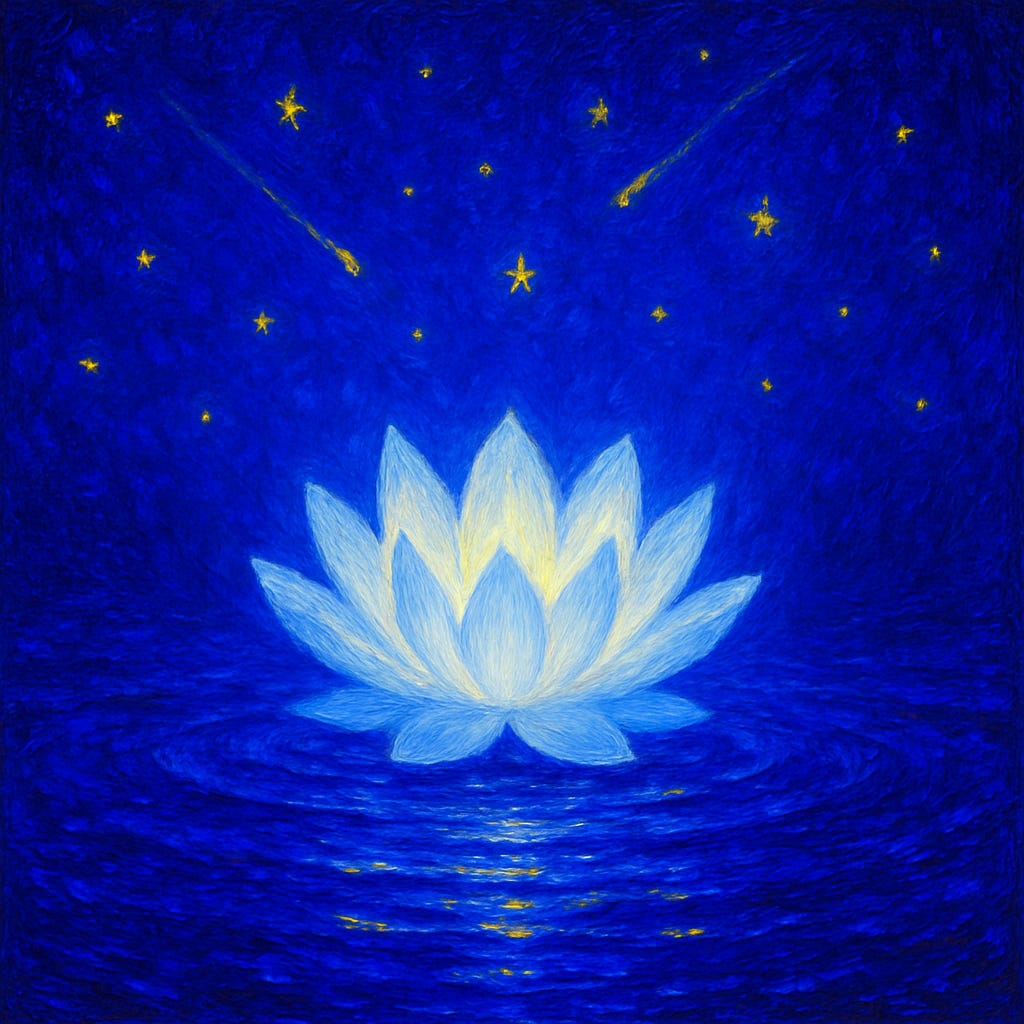
Artwork
You Are That
The Frontier Man
