


“Truth was once our bright shining star,
Now the lies stretch near and far.
Forgotten and lost, truth and trust,
Become outlaws, as facts turn to dust.”
Few phrases in modern political language are as effective at shutting down free speech as the term “conspiracy theory.” It presents itself as a neutral descriptor, even a safeguard of reason, but in practice it functions as something far more consequential and nefarious: a speech-stopping “verdict.” Once applied, debate ends, evidence becomes irrelevant, and the burden of proof silently shifts from institutions of power to the individual who dares to question them.
To understand how this happened, we must begin with what the term actually meant—before politicians started to weaponize it to shut down debate.
What the Term Means—and What It Does Not
Merriam-Webster defines conspiracy theory as:
“A theory that explains an event or set of circumstances as the result of a secret plot by usually powerful conspirators.”
This definition is striking for what it does not include. It says nothing about falsity, delusion, irrationality, or bad faith. A conspiracy theory, properly understood, is simply a proposed explanation involving secrecy and coordinated power—a claim that may be true or false, strong or weak, persuasive or absurd, depending entirely on evidence and reasoning.
And yet, in modern political discourse, the term no longer functions as a description. It functions as a delegitimization tool that denies the public any evaluation of the claim’s merits, while granting powerful actors unrestricted ability to act without public scrutiny.
To call something a “conspiracy theory” today is not used to describe its structure; it is used to end all debate on the subject.
From Analytical Term to Rhetorical Verdict
In contemporary usage, the label silently carries a bundle of unspoken instructions:
Do not investigate
Do not engage
Do not take the speaker seriously
Do not risk association
The term no longer answers the question “Is this claim true?”
It answers the question “Is this claim allowed by the powerful people or institutions?”
Words that once named categories of explanation now police the boundaries of acceptable thought. “Conspiracy theory” has become not a noun, but a dismissal mechanism—one that replaces evaluation of the merits of the claim with ostracizing the person who questioned the powerful.
The Hidden Asymmetry
The power of the term rests on a profound and rarely acknowledged asymmetry:
As we know, powerful institutions, governments, and individuals do, in fact, routinely conspire to take nefarious actions against the public
But suggesting they might do so is treated as irrational and inappropriate, shutting down free speech and allowing the powerful to evade accountability for their actions
The modern world is saturated with real conspiracies that were initially dismissed as paranoid fantasies until documentation made denial impossible: covert surveillance programs, fabricated pretexts for war, secret human experimentation, illegal intelligence operations, child abuse, and systematic media manipulation.
In these cases, the structure of the claim—hidden coordination by powerful actors—was identical to what would today be instantly branded a “conspiracy theory.”
The difference was not logic, evidence, or methodology.
The difference was time.
This reveals the term’s true function: it does not distinguish between truth and falsehood. It distinguishes between authorized narratives and unauthorized inquiry.
How Epistemology Collapsed into Authority
A healthy society evaluates claims by asking:
Is the argument coherent?
Is the evidence credible?
Is secrecy plausible given institutional structure?
If the claim is true, who is responsible?
The modern use of “conspiracy theory” replaces all of this with a single, corrosive shortcut:
Has this claim been sanctioned by the powerful?
Truth becomes a matter of alignment with the institutional consensus—often produced by the very institutions committing nefarious actions under scrutiny. Skepticism is inverted. Deference to power is rebranded as rationality.
This is not critical thinking.
It is an epistemic deception.
The CIA and the Deliberate Reengineering of the Term
This semantic transformation and weaponization was not accidental.
In the aftermath of President John F. Kennedy’s assassination, the American state faced a legitimacy crisis. A substantial number of journalists, lawyers, physicians, and public officials raised evidence-based objections to the Warren Commission’s conclusion that Lee Harvey Oswald acted alone. These critics were not fringe figures; they were methodical, credentialed, and persistent.
For intelligence agencies, this skepticism posed a systemic threat—not merely to one report, but to public trust in institutional authority.
In response, the CIA circulated an internal memorandum in 1967 advising media and opinion leaders on how to neutralize critics of the Warren Commission. The strategy did not focus on rebutting evidence. Instead, it recommended discrediting the critics themselves—questioning their motives, mental stability, and credibility—and explicitly encouraged the use of the label “conspiracy theorist.”
What the 1967 memorandum represents is not the creation of a concept, but the formalization and strategic deployment of it as an emerging rhetorical weapon. By explicitly recommending that critics be discredited rather than answered—and by encouraging the association of dissent with irrationality, paranoia, and bad faith—the state accelerated a linguistic shift already underway and legitimized it as a tool of narrative control. The significance of this moment lies not in its originality, but in its institutional endorsement of a tactic that would later become reflexive, automated, and culturally self-enforcing.
This was a turning point.
Language was repurposed as an intelligence tool.
From Strategy to Cultural Reflex
What began as a targeted political tactic quickly became a cultural habit. Once “conspiracy theory” was successfully associated with paranoia, irrationality, and social deviance, it no longer required enforcement. Journalists internalized it. Academics adopted it. Citizens learned to self-censor.
No censorship laws were needed.
No arguments had to be answered.
No documents had to be released.
The phrase itself did the work.
This is how censorship functions in societies that still call themselves free.
The Ultimate Irony
The institutional misuse of the term is especially grotesque given the historical record of those who popularized it. The same intelligence agencies that encouraged the public to mock suspicions of secret power were themselves engaged—often simultaneously—in covert regime change, disinformation campaigns, psychological operations, and illegal domestic activity.
Many of these actions were initially dismissed as “conspiracy theories.”
They were later confirmed by declassified documents.
The term thus became a shield for secrecy and a weapon to avoid public scrutiny and accountability, not a tool for discernment.
A Linguistic Deception That Ends Debate
The modern use of the term “conspiracy theory” commits a basic intellectual error.
Conspiracy describes a mode of coordination
Theory describes a proposed explanation
Neither implies falsehood.
A claim involving conspiracy is no more irrational than one involving markets, bureaucracies, or ideology. Its validity depends on evidence, logic, and explanatory power—not on whether it challenges comfort or authority.
By collapsing content into credibility, the term replaces reasoned evaluation with reputational attack. Inquiry is not refuted; it is pathologized.
When a Phrase Replaces an Argument
“Conspiracy theory” has become one of the most efficient instruments of intellectual control in modern political life precisely because it allows power to say, without argument:
Do not look here.
It is not a rebuttal.
It is not an analysis.
It is not skepticism.
It is a linguistic chokehold—tight enough to stop debate, subtle enough to feel reasonable, and vague enough to be deployed wherever inquiry becomes inconvenient.
A society that values truth and freedom of speech must treat the term with extreme caution.
A society that values truth and freedom of speech must refuse to let linguistic manipulation decide which questions are allowed to be asked.
Because the moment inquiry itself is treated as evidence of irrationality, power no longer needs to hide. It can now openly commit atrocities without any public scrutiny.
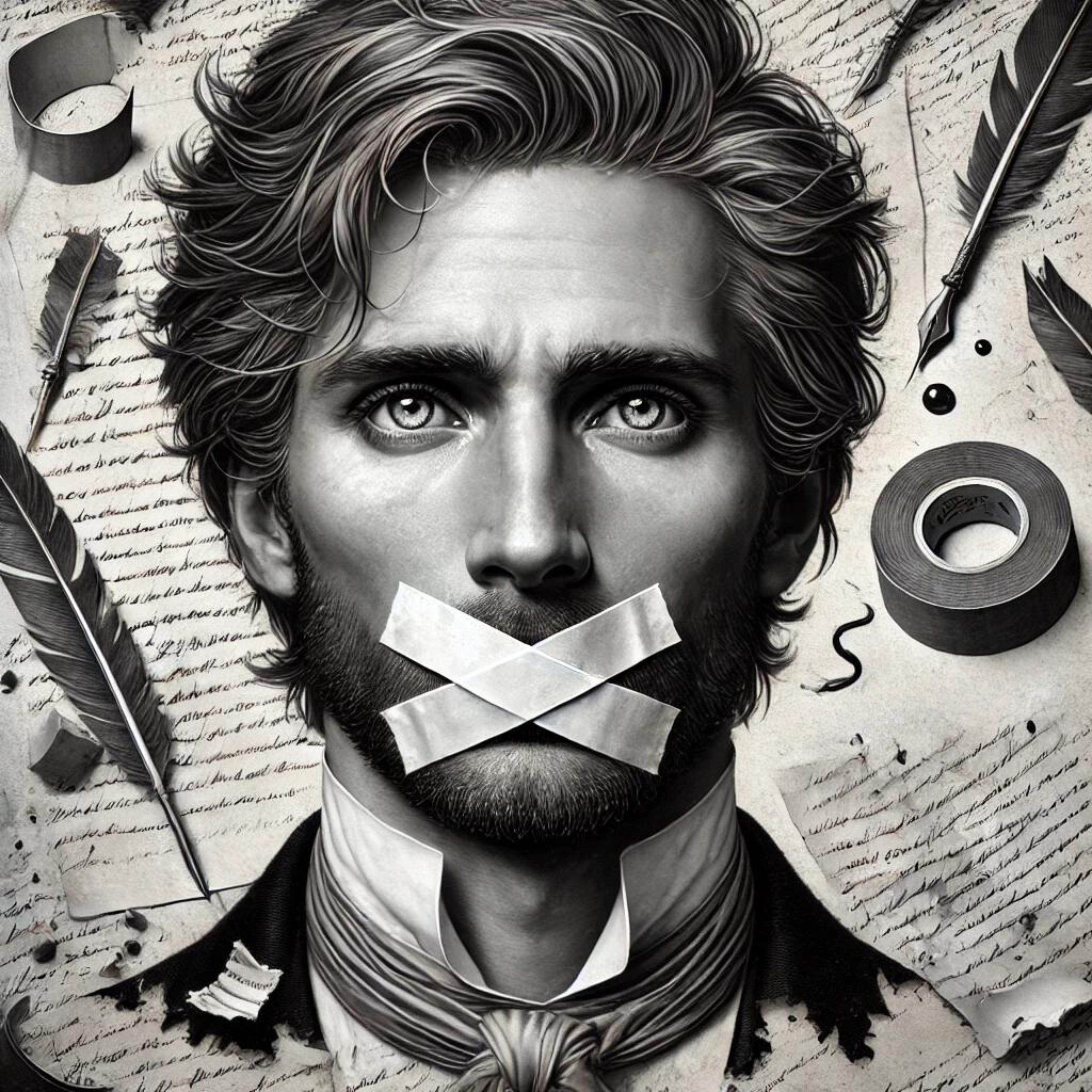
Artwork
Censored!
The Frontier Man
If a public figure says it's a conspiracy theory, it's a psyop.
If a friend tells you that, they are either afraid or already a victim of the psyop.
It is designed and used as a tool to gaslight and silence you.
Free speech is gone in the UK, you can be arrested for Facebook posts critical of the government, there’s been over 20k arrests