


“For peace is not in gold or gain,
Nor in the spoils of others’ pain;
It’s found turning from the lie,
Refusing worlds where good must die,
To stand where truth and kindness grow,
And dream a life beyond this woe.”
”Awaken” — The Frontier Man
Humanity has placed the fire of the stars in the hands of minds that still struggle to utter three simple words:
“I was wrong.”
We have learned to split the atom, guide missiles across continents and destroy cities in a flash of artificial sun. Yet we have not learned to master the pride, fear and self-deception within ourselves. Our power has grown faster than our wisdom. Our capacity to destroy has become immense while our capacity to admit error remains painfully small.
The world is at war, and the choices before us are no longer abstract. Governments and alliances are deciding whether to make peace, continue or escalate wars, send additional weapons or cross thresholds that could draw major powers into direct conflict. A decision made in a cabinet room can become an escalation on a battlefield; an escalation can become a wider war no one intended—and, in the nuclear age, a war from which there may be no return.
These are life-and-death decisions. They concern not only armies and borders, but cities, families and generations not yet born. At such a moment, rationality is not cold abstraction. It is a means of survival. We must assess the evidence as clearly as human beings can: distinguish what is achievable from what is merely desired, weigh the consequences of action and restraint, and remain willing to change course when reality changes.
That is why the study of cognitive biases, emotional motives and institutional pathologies offers such a vital way of examining decisions of war and peace. The greater the danger, the more urgently we must understand the forces that make clear judgment difficult: how pride disguises itself as honor, fear calls itself courage, stubbornness masquerades as resolve—and failure itself becomes an argument for still greater failure.
These forces do not tell us which side is right. They reveal how any side—and any alliance of nations—can become incapable of seeing when it is wrong. They cut through flags, slogans and propaganda by asking a more fundamental question: are we choosing in the light of reality—or in the shadow of the human ego?
Not every retreat is wisdom, and not every resistance is futile. There are wars in which continued defense still protects a people or improves the settlement that can be achieved. The tragedy begins when that possibility has vanished, but the human mind refuses to follow reality where it leads.
The War Within the Human Heart
The forces that blind us at such moments are not rare defects found only in tyrants, fools or monsters. They are built into the ordinary architecture of the human mind. We defend decisions we have already made, seek evidence confirming what we wish to believe, cling to what we have invested in and confuse consistency with wisdom.
Within a military alliance, these weaknesses can reinforce one another across cabinets, intelligence services and general staffs until an error in one capital becomes the solemn commitment of many. When nuclear powers are involved, failures of judgment can threaten the future of humanity itself.
The crucial question, then, is when perseverance ceases to protect the future and begins only to consume it.
A war is not lost merely because victory is distant, costly or uncertain. It is lost when no plausible course of continued fighting offers a better attainable future than the alternatives, after their probable human consequences are weighed.
To recognize that point requires more than intelligence. It requires the courage to question our own motives, assumptions and promises. A flaw we refuse to see governs us from the shadows. A flaw we name can be confronted. A pattern we understand can be broken.
Self-knowledge is therefore the first act of peace. Without it, we mistake our wounds for principles and our pride for truth. The wars raging inside the human heart eventually find expression in flags, armies, and military conflicts.
Before an alliance asks whether it possesses the courage to continue fighting or escalate a war, it must ask whether it possesses the greater courage to examine its own judgment.
Is this perseverance—or fear of admitting failure? Is this unity—or conformity? Is this honor—or collective vanity? Is this sacrifice for the people—or sacrifice of the people?
When Sacrifice Demands Another Sacrifice
Every war teaches the drums to speak louder than the human heart.
It gathers people beneath banners, amid thunderous speeches and promises of victory. Governments invoke history, destiny, honor and the dead. Together they tell the young that courage demands sacrifice and assure their families that the sacrifice will not be wasted.
But a lost war ends differently. It ends first in truth—quietly, long before the guns fall silent.
Generals still bend over their maps. Cabinets convene. Alliance councils announce new weapons, new offensives and new strategies. Commentators paint defeat in the colors of hope. Yet beneath the speeches and smoke, the strategic verdict may already have been written:
There is no plausible road to victory. Every road forward leads only to another grave.
There comes a terrible hour when a war changes its moral character. Until that hour, people may have died in pursuit of a plausible victory. Once the evidence shows that no plausible course of continued fighting can achieve a political purpose of sufficient value to justify the probable human cost, every additional death carries the added weight of those who saw the truth—and chose to bury it beneath more bodies rather than confess failure.
Modern psychology gives one part of this madness a sterile name: the sunk cost fallacy. It describes an ancient cruelty: the belief that because the altar is already red with blood, it must be fed more blood.
We have sacrificed too much to stop now. Too many have died for us to abandon the cause.
But a grave is not redeemed by digging another beside it. No child killed tomorrow can resurrect the child killed yesterday. No city burned tomorrow can rebuild the city burned yesterday.
Past sacrifices may inform us; they cannot command another sacrifice.
The Prison of Many Flags
Yet truth is precisely what the architects of a failed war may be unable to bear. Each government would have to confront what it ordered, funded, armed, defended and promised. Together they would have to acknowledge that their predictions failed, their strategy collapsed and their assurances may have cost hundreds of thousands of human lives.
And so a war can cease to be a struggle for the future. It can become a struggle to protect the reputations of those who led us to failure.
The hardest position to abandon is not merely the one in which we have invested the most blood or treasure, but the one that has become part of our identity. When identity becomes entangled with sunk costs, retreat can feel like self-betrayal.
This is escalation of commitment: evidence of failure becomes the reason to deepen the very commitment that produced it. Defeat summons another summit. A failed offensive brings another weapons package. An unfulfilled promise is followed by an even greater commitment. The deeper the alliance descends into catastrophe, the more furiously its leaders insist that victory waits just beyond the next escalation.
Within this logic, victory remains forever one battle away. Peace is always premature. Negotiation becomes betrayal, dissent becomes disunity and reality becomes forbidden.
The allied governments become prisoners not only of their own words, but of one another’s. Having promised victory together, few wish to be the first to accept compromise. Having described the enemy as absolute evil, they cannot negotiate without appearing to compromise with evil. Thus rhetoric becomes a cage, and many nations are locked inside it.
The fear of loss tightens the bars: faced with accepting a loss that now appears unavoidable, leaders may gamble on increasingly dangerous alternatives in the hope that an improbable reversal will rescue them.
But nations are not chips to be wagered, and human lives are not stakes on the poker table of history.
Within an alliance, the burden of war can be profoundly unequal. One population may endure missile strikes, amputations and coffins while distant capitals debate beneath chandeliers and bear the war’s costs chiefly in money, political capital and electoral consequences. The farther a capital stands from the graves, the easier it becomes to call continued fighting courage—and the harder to admit that weapons, sanctions, forecasts or promises have failed. Few capitals wish to become the first to say publicly what many may already have concluded privately.
No distant ally has the right to demand that another people bleed for its reputation. Neither has it the right to purchase its own safety by bargaining away another people’s future. The purpose of seeking peace is not to impose surrender from afar, but to stop demanding sacrifice from afar when sacrifice no longer buys a better attainable future.
Credibility deserves a place in the calculation, but not dominion over it. An alliance preserves little credibility by defending its reputation at the expense of the people the alliance exists to protect. Its honor resides in the courage to correct a disastrous policy and choose truth over collective vanity.
A government’s reputation is a small thing beside a nation’s future.
How monstrous that cities should burn so that public officials need not admit they were wrong. How utterly perverse that entire peoples should be made to surrender their future because their governments refuse to surrender an illusion. Does credibility lie in the wisdom to correct a catastrophic error—or in the determination to perpetuate it?
When Silence Becomes Conviction
Around the decision-makers, the machinery of collective self-deception turns.
Confirmation bias transforms every small tactical success into evidence that strategic victory remains within reach, while signs of strategic failure are reinterpreted as temporary setbacks. Motivated reasoning turns intelligence into advocacy. Facts are no longer gathered to test policy; they are selected and arranged to defend it.
Advisers discover that careers are built by telling government officials what they wish to hear. Smaller members repeat the assumptions of stronger ones, while stronger members cite that agreement as proof of universal confidence. Soon many inside the room may privately conclude that the war is lost, yet few people—and few nations—wish to be the first to say so publicly.
Groupthink, conformity and collective silence begin to reinforce one another. Each mistakes the silence of the others for conviction, creating an echo chamber that spans capitals. What few would proclaim alone, many continue to defend together.
Responsibility disappears into the same silence. Each government says that the alliance made the decision, though the alliance possesses no conscience independent of the governments that compose it. Responsibility travels around the table until collective responsibility dissolves into no responsibility at all.
Bad news changes its uniform before entering every capital. By the time truth reaches the alliance table, it has been washed, perfumed and dressed as victory.
The alliance inhabits a manufactured world, speaking of historic unity and approaching triumph while armies are exhausted, treasuries bleed and cemeteries expand. Even an approaching disaster is recast as the darkness before dawn.
But sometimes darkness is not the hour before sunrise. Sometimes it is the shadow cast by a truth we refuse to face.
The Arithmetic of the Dead
As the war continues, its victims disappear behind numbers. One dead child has a name, a face, a bedroom and a mother whose world has ended. A hundred thousand deaths collapse into a statistic on a sheet of paper.
This is psychic numbing. Human beings dissolve into abstractions: casualties, losses, manpower, collateral damage. Language places a veil over suffering, allowing those who authorize it from distant rooms to avoid seeing what their decisions really mean.
But every number was once someone’s entire world. Every soldier beneath every flag was once a child carried in someone’s arms. Every civilian beneath the ruins had memories, hopes, jokes and unfinished dreams. Every death leaves behind an expanding circle of grief that no government report can measure.
The economic destruction is hidden in the same way, divided among countries, budgets and years until no public sees the full cost. Hundreds of billions consumed by war mean hospitals never built, schools never opened, discoveries never made and cities allowed to decay.
The future is sacrificed to finance the destruction of the present.
Beneath the Black Sun
Over all of it hangs the black sun of nuclear war.
Because previous escalations did not end in catastrophe, governments begin to mistake survival for safety. A catastrophe narrowly avoided becomes permission to court a greater one. Extraordinary risk-taking becomes routine.
Each member assumes that restraint is ultimately someone else’s responsibility. But an alliance is not a single mind. It is a chain of governments, weapons, warnings and commands through which miscalculation can travel faster than correction.
A gambler who plays Russian roulette five times and survives has not proved that the game is safe. He has proved only that he has been lucky.
Luck signs no treaties. It offers no guarantees. It remembers no loyalty and promises no tomorrow.
Nuclear catastrophe need not be probable to weigh heavily in any serious calculation. Probability matters—but so does the magnitude of the possible loss. When the consequence at stake is the destruction of cities, nations and perhaps even human civilization itself, even a small probability must carry extraordinary weight—especially when the escalation creating that risk offers no plausible path to victory.
This is not strategy. It is gambling away the future of humanity.
The Futures Still Open
Once the best available evidence shows that continued fighting cannot secure a political good sufficient to justify the probable human cost of fighting on, strip the decision of rhetoric and judge each attainable course by the futures it can plausibly produce.
Close the ledger of yesterday—not because the dead are forgotten, but because they cannot be recovered. Compare only the attainable futures still open. Weigh the lives, security, freedom and prosperity at stake, together with the risks of wider war and nuclear escalation. Test every cherished assumption against the strongest evidence that contradicts it.
Strip the map of names and flags while preserving every morally relevant fact: what each attainable settlement would mean for those left behind, what dangers each course would carry and the probability of each outcome. Would we reach the same judgment from the same evidence if the flags were reversed? If none of the previous deaths, expenditures, promises and reputations stood behind us, would we choose this course today? And what observable evidence would show that the promise of victory is false?
Then ask:
From today forward, which attainable course offers the better range of probable futures once their likelihood and human consequences are weighed—including the danger of escalation and the fate of those each course leaves behind?
If the evidence cannot show that further fighting offers a better attainable future—if it cannot protect more people, improve the terms of an attainable settlement or preserve an essential political good sufficient to justify the probable human cost of continued fighting—then continued war has lost its justification.
Would the alliance knowingly sacrifice another hundred thousand lives for no better result? Would its governments spend another hundred billion dollars merely to postpone acknowledging what the evidence already shows?
If not, the alliance must stop sacrificing lives in pursuit of an unattainable outcome and use its power to secure the most just and durable settlement still available while avoiding needless additional human cost.
Ending the war will not resurrect the dead, rebuild the cities or return the stolen years. Nor will it absolve those who began it, needlessly prolonged it or deceived others to keep it alive. History may still judge. Truth may still tear the masks from those who hid behind them.
Let leaders lose office before children lose their fathers. Let an alliance lose face before we lose cities. Let banners fall before the last light in the human house goes dark.
The dead do not call us to join them; they call us to remember them. The unborn do not ask us to avenge yesterday; they ask us to leave them a tomorrow.
End a lost war before another door waits for footsteps that will never return. Before another mother is forced to learn the language of ashes. Before another generation is taught to inherit hatred as though it were a sacred birthright. Before one false alarm, one panicked decision or one misunderstood command tears the sky open.
End the war not because nothing matters, but because human life matters more than collective pride. Not because truth is weak, but because truth has finally become too powerful to silence. Not because peace is surrender, but because peace is humanity refusing to destroy itself.
Lay down the lie before it lays down the world.
Let pride be defeated by love.
Let truth rise from the ruins.
Let the missiles fall silent.
Let the living live.
🕊️💗
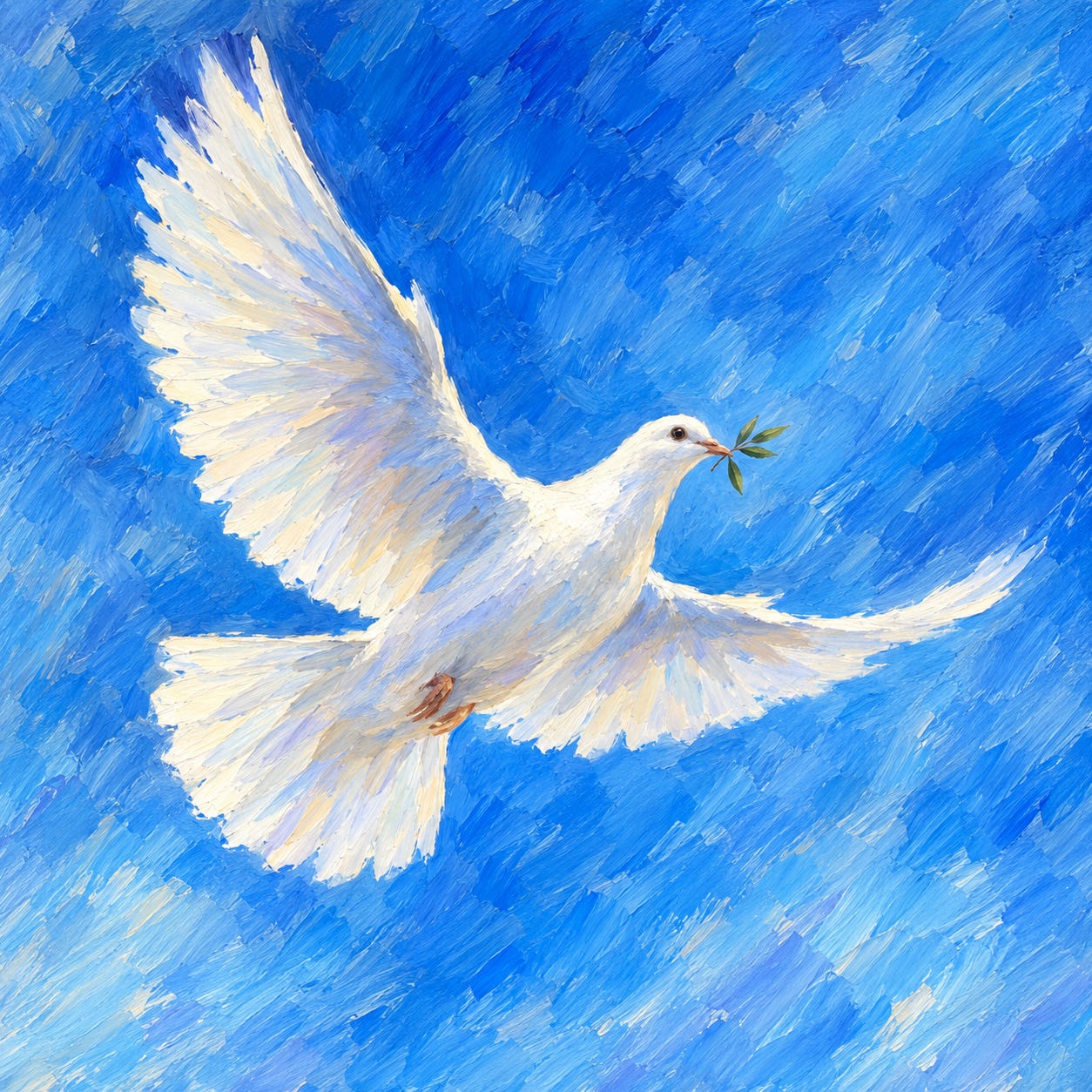
Artwork
Peace
The Frontier Man
Thank you for your kind words 🙏💕
All good, but to war profiteers who wield trillions of dollars in political influence, only wars that end are lost. From their perspective, these are in no way failures, but represent successes as they continue and even escalate.